A Skill, Not a Trick
In June I was catching up on LinkedIn and found two strangely weird ways of thinking about working with AI. On one side, very complex schemes – agents, loops, workflows. On the other, something that sounded almost like a joke: when my Claude session reaches ninety percent, I ask it to prepare a summary for GPT. The two look nothing alike, and underneath they are the same. Both are hunting for a trick. Neither is building a skill.
Working with AI is a skill, the same as searching Google is a skill. It comes out of the experience you accumulate and the goals you set for yourself, and I have not found another door into it.
When it was still AltaVista
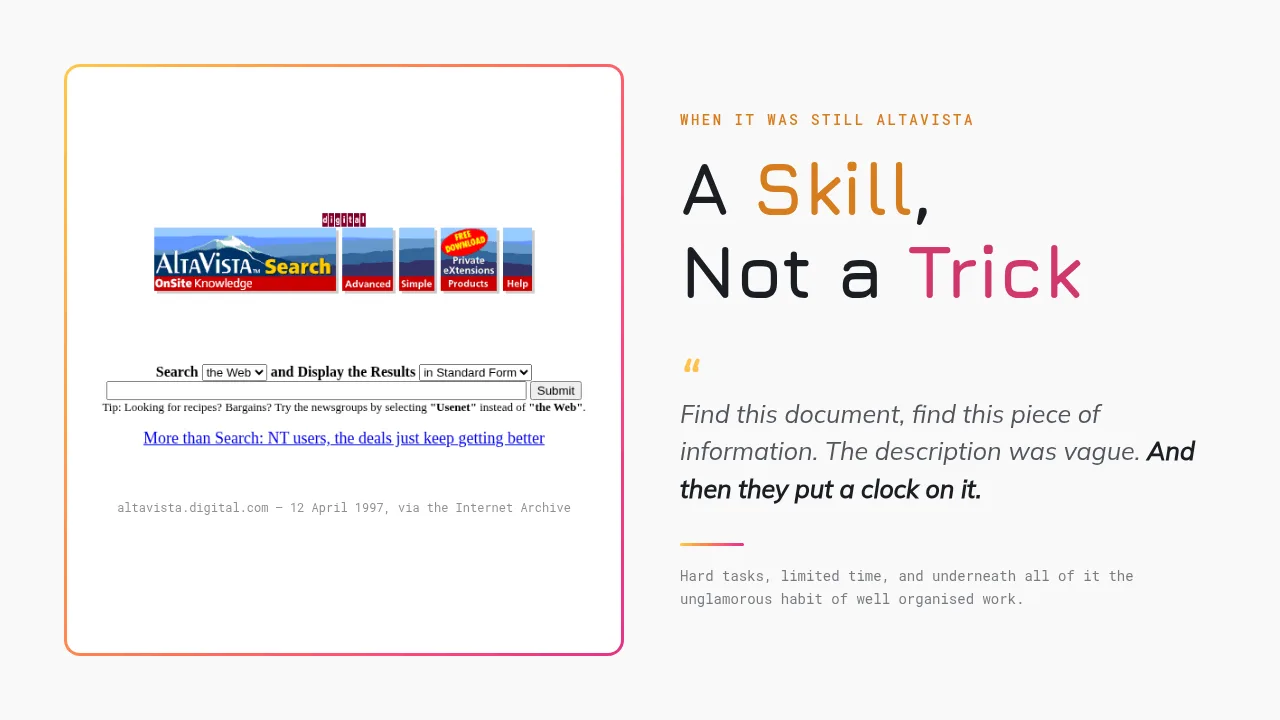
I remember the days when it was still AltaVista. One of the firms I was training with used to set us a task: find this document, find this piece of information. The description was vague. And then they put a clock on it.
That is a strange thing to drill, if you think of a search engine as a box you type into. It is not strange at all if you think of it as a skill.
Google has been with us for a great many years now – long enough, you would think, for everyone to have arrived at the same level. We did not. Some people are still far more effective with it than others.
So this is trained the way everything else you are genuinely good at was trained. Your mathematics. Your languages. Whatever professional certification you sat for. Hard tasks, limited time, and underneath all of it the unglamorous habit of well organised work.
The ore and the hammer
I wrote in June that it helps to look at AI work as mining and smithing.
You start with raw ore. You enrich it and purify it until it reaches the quality you want. Then you begin heating it, and forming it with the hammer of your intended goals, and cooling it, and reheating, and forming it again. It can span many sessions. And the ore, the metal, the thing on the anvil – that is your context.
Which gives a rule plain enough to check at the end of a day: every session of work should output at least one MD file of better quality than the inputs you brought to it. Otherwise it did not happen.
I mean that about work, not about play. Fun and leisure need no structure and no tips – each one is having fun as they want. But work that leaves no such file behind did not happen. There is nothing to reheat next time.
The same rule pointed at the everyday: all your conversations should end up in a workable file, markdown, in your own folder. You should own the results of the work. Your web sessions should never reach ninety percent in the first place – use them for short explorations and move the result into the project folder, always, so that your context around a topic stays organised.
Then you can edit it, merge it, split it. You can carry it into another Claude web session, or Claude Code, or Cursor, or Codex, or a GPT session. The work is yours and it travels.
Small projects, finished
I believe the current stage of AI is still about getting experience.
Do a small project. Make it work for you. Learn from the mistakes, make the next one, learn again. Iterate – fast, and with intent. Complete what you started, find a way around the hurdles, and build.
Not your company. Not your manager. Not your subordinate. You. No amount of reading will teach you what hands-on experience gives.
It is what I found myself saying under someone else’s project too. Not complex “business” solutions with AI. Day-to-day small projects that you do, complete, run for yourself, take the experience from, and move on. That is how you create value for yourself – through your own experience.
In that June post I also offered my memory plugin for free, and the reason was practical. It is very hard to keep going when you are mad at the AI for repeating one and the same thing over and over. Better to remove the repetition and achieve results.
In the same post I mentioned that I had been using Claude Code about twenty hours a week for sixty-five weeks. By the end of July it was seventy, and I told that story separately, including the part where the best thing I ever built has four stars on GitHub.
There is another turn to that, which I enjoy more than I probably should. They ask you: what is your GitHub? And you say, here it is, I built actually the best memory plugin for Claude Code out there. And then silence in response.
The weekend, and the weeks around it
In July there was a round of argument about whether a production-ready application in a weekend is real. I thought the question was wrong, and most of the answers with it.
The parts everyone lists as the impossible ones – architecture, CI/CD, hardening, GDPR, tests – are all parts of the same weekend now. That is simply where we are. What needs the week or two before the weekend is different work entirely: how this application fits a business need, whether it works for a user at all, user experience modelling, design, a marketing strategy if it requires one, adoption and transition. And what needs the week or two after is real users, real feedback, and another iteration.
Two weeks, a weekend, two weeks. As many times round as it takes.
There is a story about the other end of this that Andrej Karpathy told in one of his recent interviews. He built a whole agentic application for food menus: where a menu had text and no pictures, it would produce an example of what the dish should look like, so the person ordering had something to orient by. Only to find that these days the models – Nano Banana and the like – do it out of the box.
Why I write about this at all
You may be wondering why Maxim has started writing about AI, all of a sudden.
It is not my preference. I can as easily dwell in corporate culture, strategic management, project and product management, marketing, business development, and most kinds of IT topics – and that is before any of the subjects that have nothing to do with work.
So why this? Because it is trendy? To be honest I do not much mind whether you read this. I am self sufficient. But I care about my fellows and my friends, my neighbours, the people I meet. We all need to learn to use this to our own benefit. It is an economic question, not a LinkedIn topic.
Now it is AI. Later come robots. Whoever rides the wave has the advantage. And however much a state focuses on “digital”, an economy means wide adoption.
The United States has a strategy of being number one in terms of models. China has a strategy of the widest possible adoption by its population.
What strategy has Ukraine?
I asked that in July and it is still the question I would most like answered. And it is worth remembering what comes after a strategy, on the day one arrives: manhours upon manhours of teaching, mentoring and educating. AI will not help you start using AI in your daily work. Somebody has to sit down with you.
So I started with the hours I have. This site is about learning to use the tools, and the most honest thing I can put in front of you is not an argument but a sample lesson – a real one, open in the browser, nothing to sign.
The museum with the dinosaurs in it
I once described how I imagine all of this looking from the far side of it. An archaeological museum, where, with all due respect, there are pictures of dinosaurs on the walls. They were writing code by hand. In the ancient past, each coder had his own specialisation – this one wrote Python, that one C#, another one JavaScript. And children shaking their heads in disbelief.
I do not know how far away that room is. Closer than it sounds, I suspect.
And when I try to guess which skill will still be worth having by the time we get there, the honest answer is not a technical one at all. The most important skill in five years may well be the ability to spend your day productively away from the computer.
The dinosaurs on that museum wall were not doing anything wrong. They were doing the best work available to them, by hand, with great care.
So are we.
This article is assembled from things I wrote on LinkedIn in June and July 2026:
- 21 June 2026 – working with AI is a skill
- 21 June 2026 – mining and smithing
- 23 June 2026 – the current stage is about getting experience
- 5 July 2026 – why I started writing about AI
Together with comments left under other people’s posts across the same two months.
$ exit 0 – thanks for reading
The fox will keep the drafts warm.