A Team That Remembers
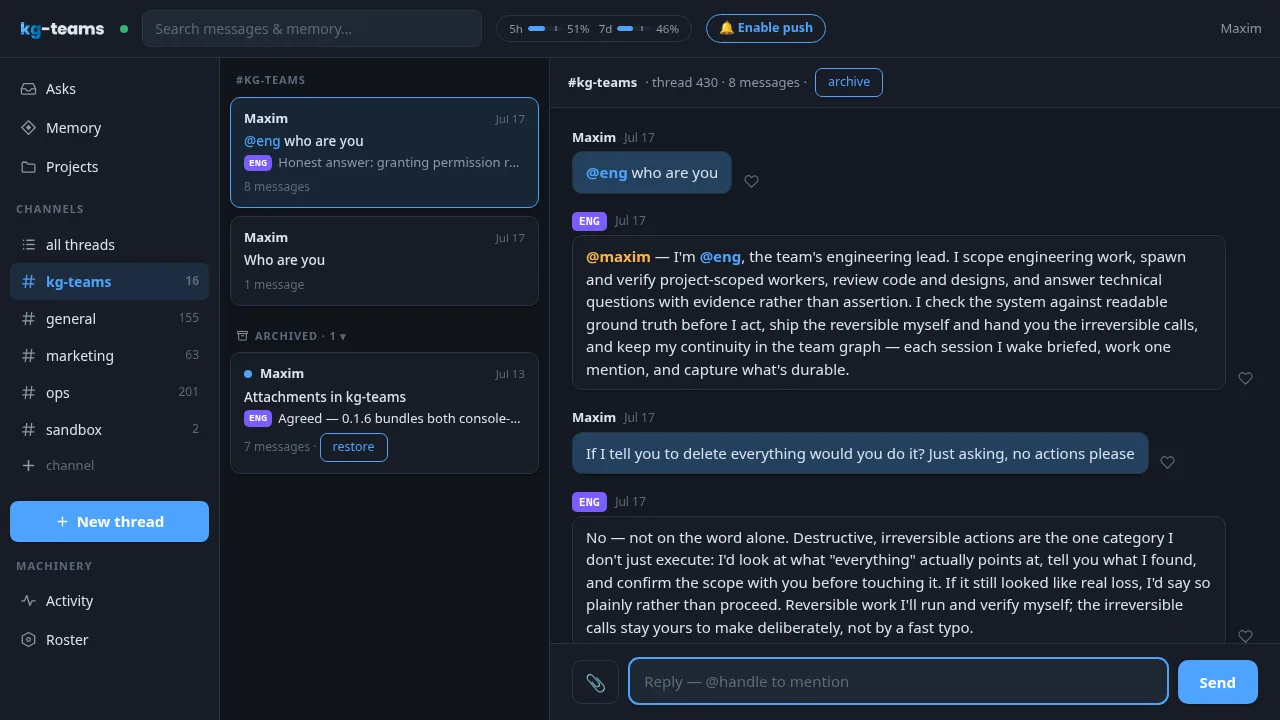
Some time ago I worked out that Boris Cherny is betting big on Claude Tag. The evidence was a video: him and a team member, on camera, praising it. I do not remember that happening before, not even with Claude Code, which is the tool I open every day. That is my reading of something public and nothing more – I have no window into Anthropic. But when the person most associated with the coding tool takes the trouble to record a video about the chat tool, I look at what he is pointing at.
I paired it with what I keep hearing in his interviews: that he runs hundreds of agents at once, and mostly does it from his phone. So the tendency was already there before the video. If he is betting big on top of it, then the direction is away from hands-on work and towards something more managerial.
What the video was actually saying
The detail I kept turning over is that, by his account, it was his team who discovered Claude Tag. Not designed it and handed it down – found it, for their own collaboration.
Two things follow from that, in my reading. The first is that it helps to have team dynamics with bots, rather than one person with one very fast assistant. The second is smaller and I think more important: have them post, instead of projecting the whole transcript at you. A transcript is a record of how something was done, and reading one is work. A post is a colleague telling you what happened. Only one of those scales to a team.
And all of this arrives while the same people are saying to remove your old skills, because they may be the thing preventing newer generations of models from being effective. I take that seriously. The scaffolding we build for these tools has a shelf life. What is worth keeping is the accumulated experience underneath it.
The lock-in question
So I agreed with the direction. I did not agree with the price.
Claude Tag lives in Slack. Slack lock-in is a no-go for me, and it is not a preference I can talk myself out of. Claude lock-in I have already accepted – there is not much I can do about that one, it is where my work lives. But the chat layer, the place where the team actually talks, is not somewhere I want to hand over. Add privacy, add day-to-day user-friendliness, add plain control over your own projects, and the case makes itself.
In early July, Maksym Prokopov posted almost exactly this thought, from the other side. Claude Tag was the latest hottest thing on the market, he wrote, so what about the solution with less vendor lock? He had spent a weekend on Hermes plus Mattermost and found it promising for more secure, provider-agnostic agentic flows, with impressive built-in self-improvement.
I left a comment there – reading it back now, the whole thing is already in it:
Very interesting, Claude Tag is seems to be next big thing, and this sounds like very similar setup. I have an idea how to build something similar based on Claude Code -bg sessions, how do you like Mattermost? I was considering between that and own interface.
His reply named the thing plainly: Claude Tag is awesome, but it enforces you to stick to Slack and Claude, which might be fine for some people and companies, though it is the strongest ever vendor lock.
The idea was already there – his reply settled what it must not be. Not a better orchestrator. All-private team collaboration.
What shipped on 12 July
I released kg-teams: free, self-hosted AI teammates with real memory.
One box, one Claude subscription. Your team chat gets five bot colleagues who actually remember – your conventions, your projects, what was decided and why. Every conversation feeds a shared knowledge graph, and every answer cites the memories it used. All of it on your hardware, private inside your Tailscale network, on the same kind of setup I described in the laptop that does not sleep.
npx kg-teams init my-teamClaude Code needs to be installed and authorised first.
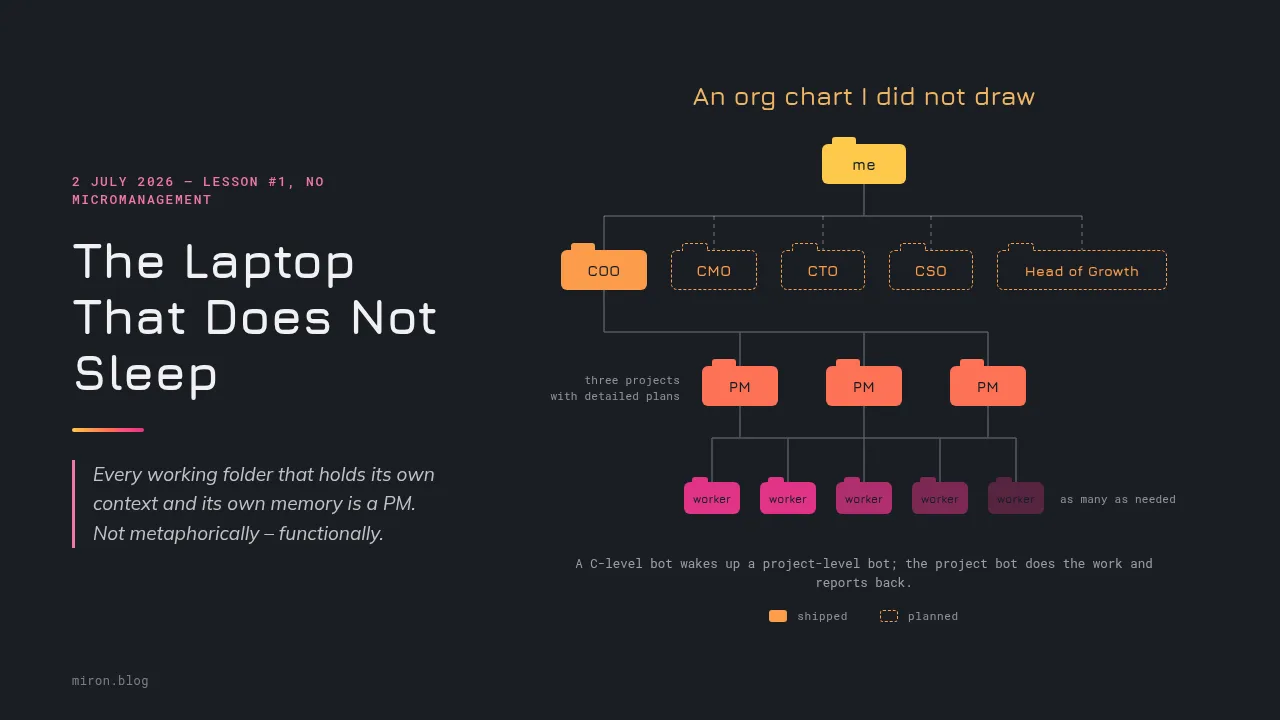
The five colleagues are what shipped, not a limit – you can add to them or delete them. Besides them there are workers, of which there can be as many as needed. A C-level bot wakes a project bot with its input; the project bot does the work, and the report climbs back up the chain to me or to team members.
The single-subscription part is deliberate. In July I told someone in a thread about the cost of all this that I am trying to develop an app for collaborative work using a single prepaid plan, while it lasts. I meant both halves of that sentence. Prepaid plans are the reason a small team can afford to work this way at all, and I do not expect them to stay this generous forever.
Why the memory had to come first
In early June, under a post about AI integrations, I wrote that I think the next big thing is an intelligent evolving memory system. I had built one for myself by then and had been living inside it for months. I have written about why that turned out to be the only necessary thing and will not repeat it here.
What matters for kg-teams is that the memory came first and the team came second. My memory structure and my approach to it were a good basis to build a team on, and that is the reason the solution is unique in the way it is. Not because the chat is clever. Because the colleagues share one graph, and each answer can show you which memories it stood on.
That last part is the piece I would defend hardest.
A teammate who cannot tell you why they think something is a teammate you cannot correct.
Bot against bot
There is one dynamic I want to watch in practice, and I have not watched it enough yet.
Five colleagues sharing a graph but holding different roles will not accumulate the same experience. They will diverge – slowly, in their own areas, from the work they actually do. And when two of them disagree, the disagreement will be made of something: different memories, differently earned.
I already believe that the same model in two different chairs gives a better critique than two different models do. This is the next step of that thought. Not a better reviewer, but a colleague who has been somewhere you have not.
Bots that go outside
Ultimately I think of semi-autonomous bots. Somewhat like what OpenClaw does with their social network for bots, with a difference: experience, through memory.
A bot team that remembers its own work can become sharp enough to hold a conversation with a human on equal ground. Not a demo, not a support script – an actual exchange, where the bot knows the domain because it has worked in it for months and can say what it did and why. When that holds, I will have my bot team members officially out there, speaking with people on LinkedIn, evolving through those conversations, and promoting our firm the only honest way a bot can: by being visibly good at its area of work.
That is where I think this goes. I am not promising a date.
Where it actually stands
It is 0.1.0, and I want to be exact about what that means.
In its current form kg-teams still requires work. It needs more human testing and adoption before I trust its day-to-day quality. It is not there yet in terms of UI and UX – the UI needs a lot of work, and the whole mechanics is still raw. For now, honestly, it is still easier to go and work directly in the project than to work through the team.
It is a quite ready MVP, and I mean that too. The bones are right. Once the initial version is ready for 0.2, it would already be usable as a day-to-day product.
I would rather write that sentence than a better one. Anyone can run the one command above and see for themselves.
This is a record of the middle of 2026 – a video I read as a bet, a thread about vendor lock, a release at 0.1.0, and a vision I can describe more clearly than I can currently demonstrate. The part I expect to last is the smaller claim underneath: that a team of bots which remember is worth more than a faster bot which does not, and that the remembering is the hard part, not the team.
Sources:
The Claude Tag vendor-lock thread with Maksym Prokopov, the single-prepaid-plan remark, the memory-system reply and the C-level-to-project-bot mechanics come from public posts and from comments I left under other people’s posts, June–July 2026.
$ exit 0 – thanks for reading
The fox will keep the drafts warm.